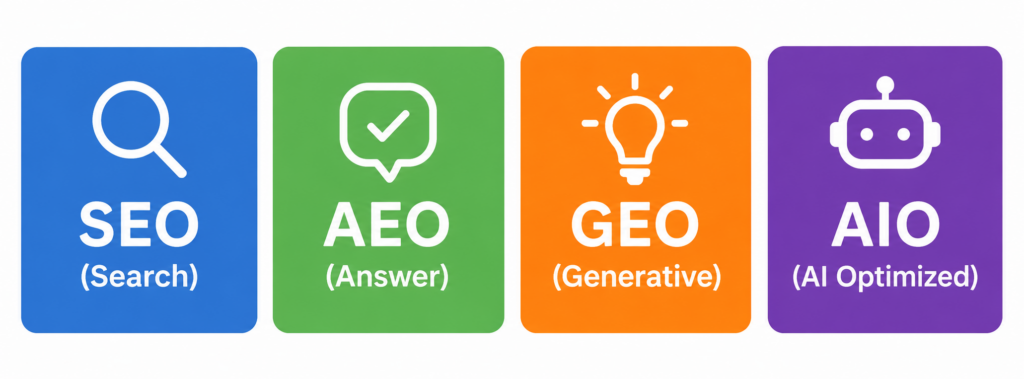
Excellanto introduces Artificial Intelligence Optimization (AIO) in SEO as the next evolution of digital marketing and search engine optimization. Traditional SEO focused on keywords, backlinks, and rankings, but modern search systems are now driven by artificial intelligence, machine learning, and user intent understanding. Businesses that rely only on basic SEO marketing are missing a major part of search visibility.
AIO in SEO refers to optimizing websites, content, and digital presence for AI-powered search engines, intelligent algorithms, and automated decision systems. It combines internet marketing, SEO marketing, AI-driven insights, and data-based optimization strategies to create a smarter and more adaptive digital presence.
Understanding Artificial Intelligence Optimization in SEO
Artificial Intelligence Optimization is not a replacement for SEO—it is an advanced layer built on top of it. It enhances traditional SEO by making strategies more intelligent, predictive, and responsive.
Instead of focusing only on keywords, AIO focuses on:
User behavior patterns
Search intent analysis
Contextual relevance
Predictive search trends
Machine learning algorithms
What is Difference Between Traditional SEO and AIO in SEO
Factor
Traditional SEO
AIO in SEO
Focus
Keywords & rankings
Intent & intelligence
Strategy
Manual optimization
Data-driven automation
Content
Keyword-based
Context & meaning-based
Updates
Periodic
Continuous learning
Goal
Traffic
Smart visibility & conversions
Traditional SEO helps users find you. AIO ensures you are understood, recommended, and prioritized by AI systems.
Why AIO is Becoming Essential in Digital Marketing
Search engines are becoming smarter. Platforms now use AI to interpret queries, predict needs, and deliver personalized results.
This means:
Users get direct answers instead of browsing multiple pages
Search engines prioritize relevance over keywords
AI systems recommend content based on context
Excellanto integrates AIO into digital marketing strategies to ensure businesses stay visible in AI-driven ecosystems, voice search, and intelligent platforms.
Core Components of AIO in SEO
1. AI-Based Keyword Intelligence
AIO uses advanced tools to identify not just keywords but intent clusters, semantic variations, and conversational queries. This improves targeting and aligns content with real user behavior.
2. Search Intent Optimization
Understanding why users search is more important than what they search. AIO focuses on informational, transactional, and navigational intent to create meaningful content.
3. Semantic SEO and Contextual Content
Content is optimized for meaning rather than repetition. AI systems understand relationships between topics, making semantic SEO critical.
4. Predictive Search Optimization
AIO uses data trends to predict future searches and optimize content in advance. This gives businesses a competitive advantage.
5. AI Content Structuring
Content is formatted in a way that AI systems can easily interpret and extract. This includes structured headings, clear answers, and logical flow.
How Excellanto Implements AIO in SEO
Excellanto combines traditional SEO marketing with AI-driven optimization to create a complete digital strategy.
Step-by-Step AIO Process
Step
Action
Outcome
Analysis
Website audit & AI data analysis
Clear insights
Research
Keyword + intent mapping
Accurate targeting
Optimization
Content + technical improvements
Better visibility
AI Integration
Predictive & semantic optimization
Future-ready SEO
Monitoring
Continuous AI tracking
Ongoing improvement
This approach ensures that your business is not only optimized for search engines but also for AI-powered discovery systems.
Technical SEO and AIO Integration
AIO cannot function effectively without strong technical SEO. Excellanto ensures that all technical elements are optimized for AI interpretation.
Key technical areas include:
Website speed and performance
Mobile-first optimization
Structured data implementation
Clean URL architecture
Crawlability and indexing
These elements allow AI systems to process and rank your content more effectively.
Content Strategy for AIO in SEO
Content plays a central role in AIO. Unlike traditional SEO, where keyword density mattered, AIO focuses on clarity, depth, and relevance.
AIO Content Approach
Write for humans first, optimize for AI
Use natural language and conversational tone
Answer real user queries clearly
Cover topics in depth
Use structured formats like tables and lists
This ensures your content is both user-friendly and AI-compatible.
Role of AI Tools in AIO SEO
AI tools help automate and enhance SEO processes. Excellanto uses advanced tools to improve efficiency and accuracy.
These tools assist in:
Keyword research and clustering
Content generation and optimization
Competitor analysis
Performance tracking
Predictive insights
AI tools reduce manual effort and improve decision-making accuracy.
AIO and Voice Search Optimization
Voice search is growing rapidly, and AIO plays a key role in optimizing for it. Users speak differently than they type, which requires a new approach.
AIO optimizes for:
Conversational queries
Natural language processing
Question-based content
Quick and direct answers
This improves visibility in voice-based search systems.
Benefits of AIO in SEO for Businesses
AIO offers multiple advantages over traditional SEO.
Key Benefits
Better alignment with user intent
Higher engagement and retention
Improved visibility in AI search systems
Faster adaptation to search trends
Increased conversion rates
Businesses using AIO gain a competitive edge in modern digital marketing.
Common Mistakes to Avoid in AIO SEO
Even with advanced strategies, mistakes can limit performance.
Avoid:
Over-reliance on keywords
Ignoring technical SEO
Creating shallow content
Not updating strategies regularly
Ignoring user intent
Excellanto ensures all strategies are aligned with modern AI-driven search requirements.
Future of AIO in SEO and Digital Marketing
The future of SEO is deeply connected with AI. Search engines will continue to evolve toward predictive, conversational, and personalized experiences.
Future trends include:
AI-first search engines
Real-time content recommendations
Hyper-personalized search results
Integration with generative AI platforms
Businesses that adopt AIO early will have a strong advantage in digital visibility.
Why Choose Excellanto for AIO SEO Services
Excellanto combines AI-powered digital marketing, SEO marketing, and internet marketing strategies to deliver measurable results.
We focus on:
Intelligent optimization systems
Data-driven decision making
Continuous performance improvement
Customized strategies for each business
How to Implement AIO in Real SEO Projects
Understanding AIO in SEO is important, but real business growth comes from practical implementation. Excellanto focuses on turning AI-driven SEO strategies into real, measurable outcomes by following a structured execution model. This is not about adding AI tools randomly—it is about building a system where SEO marketing, digital marketing, and AI optimization work together in a controlled process.
Step 1: Deep Website and Data Analysis
The first step in AIO implementation is understanding your current digital position. Without proper analysis, optimization becomes guesswork instead of strategy.
We begin by:
Running a complete technical SEO audit
Analyzing existing keyword rankings and traffic
Studying user behavior patterns
Identifying content gaps and weak pages
This creates a clear baseline from which AI-driven improvements can be applied effectively.
Step 2: AI-Powered Keyword and Intent Mapping
Traditional keyword research is no longer enough. AIO requires identifying intent clusters and semantic keyword groups instead of isolated keywords.
Execution includes:
Mapping primary keywords with related search queries
Identifying long-tail and conversational keywords
Grouping keywords based on user intent
Aligning keywords with specific pages
This ensures that your website speaks the same language as users and AI systems.
Step 3: Content Restructuring for AI Understanding
Content must be rewritten and structured so that both users and AI systems can easily understand it.
We implement:
Clear heading hierarchy (H1, H2, H3)
Short, direct answer sections
Structured paragraphs and lists
Context-rich explanations
This improves your chances of appearing in featured snippets, voice search, and AI-generated answers.
Step 4: Semantic SEO and Context Optimization
AIO focuses on meaning, not repetition. Content must cover topics deeply and naturally.
Execution includes:
Expanding topics with related subtopics
Using natural keyword variations across content
Connecting ideas logically within the page
Avoiding keyword stuffing
This helps AI systems understand your content as a complete information source.
Step 5: Technical SEO Alignment with AI Systems
AI optimization depends heavily on technical SEO. Without it, even strong content may fail to perform.
We optimize:
Website speed and performance
Mobile usability
Crawlability and indexing
Structured data (schema markup)
Clean URL structure
This ensures your website is fully accessible to both search engines and AI algorithms.
Step 6: AI-Driven Content Expansion Strategy
AIO is not about one page—it is about building a complete content ecosystem.
We create:
Topic clusters around core services
Supporting articles and guides
FAQ sections for answer optimization
Interlinked content for better navigation
This increases authority and improves your chances of being recognized by AI systems.
Step 7: Optimization for Voice and Conversational Search
Modern users search using natural language, especially through voice assistants.
We implement:
Question-based headings
Conversational tone in content
Direct and clear answers
Natural sentence structures
This improves visibility in voice search and AI-based query systems.
Step 8: Continuous AI Monitoring and Optimization
AIO is not a one-time setup. It requires continuous tracking and refinement.
We monitor:
Keyword performance
User engagement metrics
AI visibility signals
Content effectiveness
Based on this data, strategies are updated regularly to maintain performance.
Real Implementation Framework Used by Excellanto
Stage
Action
Practical Execution
Result
Audit
Website + SEO analysis
Tools + manual review
Clear baseline
Research
AI keyword mapping
Intent clustering
Accurate targeting
Optimization
Content + technical SEO
Page-level improvements
Better visibility
Expansion
Content ecosystem
Blogs, FAQs, clusters
Authority growth
Monitoring
AI + analytics tracking
Continuous updates
Long-term results
How Businesses Can Start Implementing AIO Today
Businesses do not need to completely replace their SEO strategy. Instead, they should upgrade it step-by-step.
Start with:
Improving existing content with intent-based structure
Adding FAQ and answer-focused sections
Optimizing technical SEO elements
Using AI tools for insights and improvements
This gradual approach ensures smooth transition from traditional SEO to AI-driven optimization.
Turning Strategy into Real Business Growth
AIO in SEO is only effective when it is implemented consistently and strategically. Excellanto focuses on building systems where every part of digital marketing works together—SEO, content, AI, and performance tracking.
This creates:
Strong search visibility
Better user engagement
Higher conversion rates
Sustainable digital growth
By following a structured AIO implementation process, businesses can move beyond basic rankings and achieve true digital dominance.
Advanced AIO SEO Execution for Scalable Growth
Once the foundational AIO steps are implemented, the next phase is scaling your optimization efforts to achieve consistent and expanding growth. Excellanto focuses on transforming AIO strategies into repeatable systems that continuously generate visibility, traffic, and conversions without relying on isolated actions.
At this stage, businesses move from basic optimization to intelligent search dominance, where their content, website, and digital presence become interconnected assets working together.
Building Topic Authority with AI-Driven Content Clusters
AIO in SEO becomes powerful when your website is not just optimized page-by-page but structured as a complete knowledge system. AI search engines prioritize sources that demonstrate authority across a topic rather than isolated content pieces.
We implement:
Core service pages targeting primary keywords
Supporting pages covering subtopics and variations
Deep-dive guides answering complex user queries
Interlinking strategies connecting all content
This approach signals to AI systems that your website is a trusted and comprehensive source, increasing your chances of higher visibility and recommendations.
Entity-Based SEO and AI Recognition
Modern search engines and AI systems rely heavily on entity recognition instead of just keywords. Your business must be clearly defined as an entity across the digital ecosystem.
Execution includes:
Defining brand, services, and categories consistently
Using structured data for entity clarity
Maintaining consistent business information across platforms
Building topical relevance through connected content
This helps AI systems understand who you are, what you offer, and where you belong in the market, improving both ranking and recommendation potential.
Multi-Layer Content Optimization for AI Systems
Content should be optimized at multiple levels to maximize AIO performance.
Layered Optimization Strategy
Layer
Optimization Focus
Practical Execution
Result
Surface Layer
Readability & UX
Clear headings, formatting
Better engagement
SEO Layer
Keywords & structure
On-page optimization
Ranking improvement
AIO Layer
Context & intent
Semantic content
AI understanding
GEO Layer
Conversational depth
Natural language flow
AI inclusion
This layered system ensures your content performs across search engines, AI tools, and generative platforms simultaneously.
Leveraging AI Tools for Continuous Optimization
AI tools are not just for research—they are essential for continuous improvement. Excellanto integrates AI tools into daily SEO workflows to maintain performance and identify opportunities.
We use AI to:
Detect emerging keyword trends
Analyze user engagement patterns
Identify underperforming content
Suggest optimization improvements
This allows businesses to stay ahead of changes instead of reacting late.
Conversion-Focused AIO Strategy
AIO is not only about visibility—it must lead to business growth. Excellanto aligns SEO strategies with conversion goals to ensure traffic turns into real results.
We optimize:
Landing page structure and messaging
Call-to-action placement and clarity
User journey and navigation flow
Content relevance for decision-making
This ensures users not only find your business but also take action.
Integrating AIO with Full Digital Marketing Systems
AIO works best when combined with other digital marketing efforts. Excellanto connects SEO with broader marketing strategies to maximize impact.
Integration includes:
Social media content alignment
Paid campaign support
Email marketing connections
Website promotion strategies
This creates a unified system where all channels support each other, improving overall performance.
Real-Time Adaptation to Search Engine Changes
Search algorithms and AI systems evolve continuously. AIO requires flexibility and quick adaptation to maintain performance.
We ensure:
Regular content updates
Strategy adjustments based on trends
Continuous monitoring of ranking signals
Rapid implementation of improvements
This keeps your business aligned with current and future search environments.
Measuring Success in AIO SEO
Success in AIO is measured differently from traditional SEO. It goes beyond rankings and focuses on overall digital impact.
Key performance indicators include:
Organic traffic growth
User engagement and time spent
Visibility in AI-generated responses
Conversion rates and lead generation
These metrics provide a complete view of how your strategy is performing.
Common Challenges in AIO Implementation and How Excellanto Solves Them
Many businesses struggle with AIO because they approach it without structure.
Challenges & Solutions
Challenge
Problem
Excellanto Solution
Lack of clarity
No defined strategy
Structured AIO framework
Poor content quality
Low engagement
Intent-driven content
Technical issues
Poor performance
Full technical SEO fixes
No consistency
Irregular updates
Continuous optimization
Limited understanding
Outdated SEO approach
AI-driven strategy integration
By addressing these challenges, we ensure smooth and effective implementation.
From Optimization to Market Leadership
AIO in SEO is not just about improving rankings—it is about establishing your business as a leader in your industry. When your website consistently provides value, answers queries, and aligns with AI systems, it becomes a preferred source.
Excellanto focuses on building:
Long-term authority
Consistent visibility
Strong brand recognition
Sustainable growth systems
This transforms your digital presence from a simple website into a powerful business asset.
Start Your AI-Driven SEO Journey Today
AIO in SEO is not just a trend—it is the future of search optimization. Businesses that adapt to AI-driven strategies will lead the market.
👉 Connect with Excellanto today and transform your digital marketing with Artificial Intelligence Optimization.
AIO in SEO FAQs
1. What is AIO in SEO and how is it different from traditional SEO?
AIO in SEO focuses on optimizing content for AI-driven systems rather than just search engines. It combines search intent, behavior analysis, and semantic understanding. Unlike traditional SEO, it is not limited to keywords and rankings. It ensures your content is understood and recommended by AI platforms.
2. How does AIO improve search visibility beyond rankings?
AIO helps your content appear in AI-generated answers, voice search, and smart recommendations. It expands visibility across multiple digital touchpoints. Instead of only ranking pages, it increases presence in AI-driven results. This creates broader and more consistent exposure.
3. Why is AIO important for modern digital marketing strategies?
Search engines are evolving into AI-based systems that prioritize context and intent. AIO ensures your content aligns with these advanced algorithms. It helps businesses stay relevant in changing search environments. This makes it a critical part of modern digital marketing.
4. How do you start implementing AIO on an existing website?
The process begins with a full SEO audit and content analysis. Then, content is restructured based on user intent and semantic relevance. Technical improvements and AI-friendly formatting are applied. This step-by-step approach ensures smooth integration.
5. What changes are required in website content for AIO?
Content needs to move from keyword repetition to meaning-driven writing. It should include clear explanations, structured sections, and natural language. Adding FAQs and answer-based content improves AI understanding. This makes content more accessible to both users and machines.
6. How does keyword strategy change with AIO in SEO?
Instead of targeting single keywords, AIO focuses on clusters of related terms. These clusters reflect real user intent and search behavior. It includes long-tail and conversational keywords. This creates more accurate targeting.
7. What role does user intent play in AIO optimization?
User intent becomes the central focus in AIO strategies. Content is designed to answer real problems and questions. This improves engagement and satisfaction. It also increases the chances of being selected by AI systems.
8. How do structured headings improve AIO performance?
Structured headings help AI systems understand the hierarchy of content. They make it easier to extract information quickly. Using question-based headings improves answer visibility. This enhances both SEO and AEO performance.
9. Why are FAQs important in AIO-based SEO pages?
FAQs directly address user queries in a structured format. They improve chances of appearing in featured snippets and AI responses. They also enhance user experience by providing quick answers. This makes them essential for AIO implementation.
10. How does content depth impact AIO SEO performance?
AI systems prefer comprehensive and detailed content over shallow pages. Deep content covers topics from multiple angles. It builds authority and trust. This increases visibility in both search engines and AI platforms.
11. What technical SEO elements are important for AIO?
Technical SEO ensures your website is accessible to AI systems. This includes speed, mobile optimization, and proper indexing. Structured data also plays a key role. Without technical optimization, AIO cannot perform effectively.
12. How does schema markup support AIO strategies?
Schema provides structured information that AI systems can easily interpret. It helps highlight key content elements like FAQs and services. This improves chances of rich results. It also enhances overall visibility.
13. How do AI tools support SEO optimization?
AI tools analyze large amounts of data quickly and accurately. They identify trends, gaps, and opportunities. This helps refine strategies continuously. It improves efficiency and decision-making.
14. What is semantic SEO and why is it important in AIO?
Semantic SEO focuses on meaning rather than exact keywords. It connects related topics and ideas within content. This helps AI systems understand context better. It improves overall relevance.
15. How does AIO impact content writing style?
Content becomes more natural, conversational, and informative. It focuses on clarity rather than keyword stuffing. This improves readability and engagement. It also aligns with AI processing.
16. How do you optimize a page for AI-generated answers?
Content should include clear, concise answers within structured sections. It should address common user queries directly. Proper formatting improves extraction by AI systems. This increases inclusion in AI responses.
17. What role does internal linking play in AIO?
Internal linking connects related topics and builds content structure. It helps AI understand relationships between pages. This improves overall site authority. It also enhances user navigation.
18. How does AIO affect local SEO strategies?
AIO improves local visibility by aligning content with location-based intent. It uses geo-specific keywords naturally. This helps businesses appear in relevant local searches. It strengthens regional presence.
19. How do you measure success in AIO SEO?
Success is measured through engagement, conversions, and AI visibility. Rankings alone are not enough. Metrics like time on page and click behavior are important. These reflect real user interaction.
20. How often should AIO strategies be updated?
AIO requires continuous optimization based on data and trends. Content and strategies should be updated regularly. This keeps your website relevant. It ensures consistent performance.
21. How does AIO improve conversion rates?
By aligning content with user intent, AIO attracts more relevant traffic. Users find exactly what they need. This increases trust and engagement. As a result, conversions improve.
22. What is the role of content structure in AI SEO?
Well-structured content improves readability and understanding. It allows AI systems to extract information efficiently. This increases chances of ranking in advanced search formats. It also improves user experience.
23. How does AIO integrate with digital marketing strategies?
AIO works alongside SEO, content marketing, and paid campaigns. It enhances overall visibility and performance. This creates a unified marketing system. It maximizes impact.
24. How do you optimize for voice search using AIO?
Voice search requires conversational and natural language content. Questions and direct answers are important. This aligns with how users speak. It improves visibility in voice-based queries.
25. How does AIO help in competitive markets?
AIO identifies gaps and opportunities using data insights. It helps create more relevant and targeted strategies. This improves positioning against competitors. It increases visibility.
26. How does AIO help improve content relevance for users?
AIO analyzes user behavior and search intent to align content with real needs. It ensures your content answers specific queries instead of being generic. This improves engagement and satisfaction. As a result, users stay longer and interact more.
27. What is the role of AI in keyword clustering?
AI groups related keywords based on meaning and intent rather than just similarity. This helps create content that covers entire topics instead of isolated keywords. It improves topical authority. This approach increases visibility across multiple queries.
28. How do you convert old SEO content into AIO-optimized content?
Existing content is restructured with better headings, deeper explanations, and semantic keywords. FAQs and answer-based sections are added. Content is expanded to cover complete topics. This transforms outdated pages into high-performing assets.
29. How does AIO impact on-page SEO elements?
On-page SEO shifts from keyword placement to intent-based optimization. Titles, headings, and content are written naturally. Structure becomes more important than repetition. This improves both readability and AI understanding.
30. What kind of content performs best in AIO SEO?
Content that is detailed, structured, and user-focused performs best. It should answer questions clearly and cover topics comprehensively. Conversational tone improves accessibility. This increases chances of AI selection.
31. How do AI algorithms evaluate website content?
AI algorithms analyze context, structure, and relevance of content. They look at how well content answers queries. Engagement signals also play a role. This helps determine quality and usefulness.
32. How does AIO improve website engagement metrics?
AIO aligns content with user expectations, making it more useful. This increases time on page and reduces bounce rates. Better engagement signals improve rankings. It also enhances conversion potential.
33. What is the importance of natural language in AIO?
Natural language makes content easier for both users and AI to understand. It reflects how people actually search and communicate. This improves relevance and readability. It also supports voice search optimization.
34. How does AIO influence content updates?
Content must be updated regularly to stay relevant. AIO uses data insights to identify what needs improvement. This ensures content remains accurate and useful. Continuous updates improve performance over time.
35. How do you optimize landing pages using AIO?
Landing pages are structured to match user intent and guide action. Clear messaging and logical flow are essential. Content should address user concerns directly. This improves conversions and engagement.
36. How does AIO improve search intent targeting?
AIO identifies different types of intent behind queries. Content is tailored to match informational, transactional, or navigational needs. This improves accuracy in targeting. It leads to better user satisfaction.
37. What role does content hierarchy play in AIO?
Content hierarchy organizes information in a logical structure. This helps AI systems understand relationships between sections. It improves readability and navigation. Strong hierarchy supports better indexing.
38. How do you create AI-friendly content formats?
Use structured layouts like tables, lists, and short paragraphs. Provide direct answers to questions. Maintain clarity and flow throughout the content. This helps AI systems extract information easily.
39. How does AIO support multi-channel digital marketing?
AIO aligns SEO with social media, content marketing, and paid campaigns. It ensures consistent messaging across channels. This improves brand visibility. It also enhances overall performance.
40. What is the role of data analytics in AIO SEO?
Data analytics provides insights into user behavior and performance. It helps identify trends and opportunities. This allows continuous optimization. It ensures strategies remain effective.
41. How do you build authority using AIO strategies?
Authority is built through comprehensive and high-quality content. Consistency and depth are key factors. Backlinks and credibility also play a role. This improves trust and visibility.
42. How does AIO handle long-tail keywords?
AIO naturally integrates long-tail keywords into content. These keywords reflect real user queries. They improve targeting accuracy. This increases chances of ranking for specific searches.
43. What is the impact of AIO on SERP features?
AIO improves chances of appearing in featured snippets and rich results. It also supports visibility in AI-generated answers. This expands presence beyond traditional rankings. It increases overall reach.
44. How do you optimize for zero-click searches using AIO?
Provide direct answers within content. Structure information clearly for quick extraction. This helps appear in snippets and AI responses. It improves visibility even without clicks.
45. How does AIO influence content personalization?
AIO uses data to tailor content based on user preferences. This improves relevance and engagement. Personalized content performs better. It increases user satisfaction.
46. How does Excellanto implement AIO in real projects?
Excellanto combines SEO audits, AI tools, and structured strategies. We optimize content, technical elements, and user experience together. Continuous monitoring ensures improvement. This creates long-term results.
47. What mistakes should businesses avoid in AIO SEO?
Avoid focusing only on keywords and ignoring user intent. Do not create shallow content. Technical SEO should not be neglected. Consistency is essential for success.
48. How does AIO improve conversion-focused SEO strategies?
AIO aligns content with user decision-making stages. It provides relevant information at the right time. This builds trust and confidence. It increases conversion rates.
49. How does AIO prepare websites for future search trends?
AIO adapts to AI-driven and conversational search systems. It ensures content remains relevant in evolving environments. This future-proofs your digital presence. It maintains competitiveness.
50. Why is AIO considered the future of SEO?
AIO integrates intelligence, automation, and user-focused strategies. It aligns with how modern search systems work. Businesses adopting AIO gain a competitive advantage. It represents the next stage of SEO evolution.